Project Management · 12 min read
What a Construction Site Can Teach Your Startup About Deadlines
Nobody pours concrete "when it feels right." Here is how job sites protect deadlines, and how a startup can borrow the habit.
 Dennis AlejoProject manager · Civil engineer · · 2,694 words

I grew up around construction sites, and one lesson arrived before I could even drive: concrete does not care about your mood. When the truck shows up, the pour happens. Not when the team feels ready, not after one more coffee, not once the founder has finished a particularly inspiring meeting. The truck is there, the crew is there, the clock on the concrete is running, and everything that was supposed to be finished before that moment either is or is not.
Years later, working in the United States with startups and growing companies, I kept noticing the same story told in a different accent. Someone promises a launch for the end of the month. Everyone nods. The date goes on a slide. And then, like clockwork, the date turns into a mood: "we're close," "almost there," "just a few things left." A construction site cannot afford that vocabulary, because on a construction site a missed dependency has a very physical way of announcing itself. A startup can afford it a little longer, which is exactly why startups are so good at missing deadlines.
The good news is that you can borrow the habits that keep job sites honest without ever putting on a hard hat. This article walks through them in plain language: how real dates are built, how to keep tasks from going orphaned, what to ask every Monday, and how to tell the truth about delays early enough to do something useful. Somewhere in the middle there is a small tool you can use to score your own team. And there is a comment box at the end, because I would genuinely like to hear about the last deadline that got away from you.
Deadlines are dependencies, not wishes
Picture a house going up. The electrician cannot start until the walls are framed. The walls cannot be framed until the foundation has cured. The foundation cannot be poured until the formwork and the steel are inspected. Nobody on that site would say "the electrical is due on Friday" simply because Friday sounds nice. Friday exists because three other things have to happen first, and each of them takes a stubborn, non-negotiable amount of time.
Most startups set their dates the other way around. A founder picks something that feels ambitious, announces it, and then everyone works backwards trying to make reality fit. It feels motivating for about two days. After that it feels like carrying a sofa up a staircase that keeps getting longer.
Here is a better habit. Before you promise any date, write down what the work is waiting for. Not a long document: a simple list, task by task, with one extra column that says "waiting on." You will be surprised how often the real deadline appears in that column, and how often the thing quietly blocking you is not a task at all but a decision, a signature, a password, or a person on vacation.
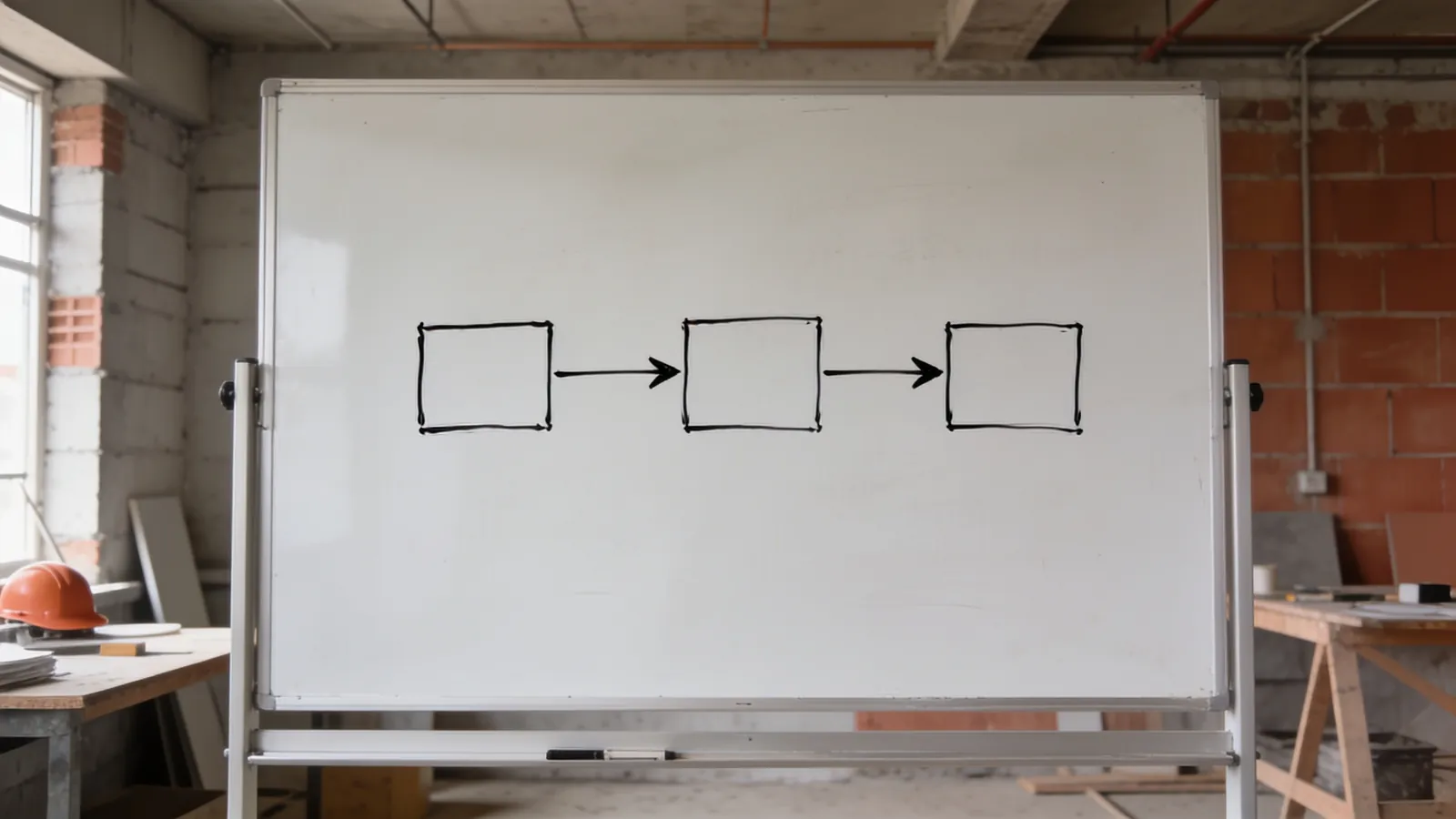
Try this with your next launch. Take a whiteboard, or the back of an envelope, and draw boxes for the ten or fifteen things that must be true on launch day. Now draw arrows from each box to whatever it depends on. If a box has no arrows pointing into it, it can start today. If a box has three arrows pointing into it, it is a meeting waiting to happen, and probably the place where your timeline will go to die.
Find the critical path, because it sets your real date
Once you have the arrows, one chain of boxes will turn out to be longer than the others. That chain is called the critical path, and it is the single most useful idea I carried from large construction programs into everyday business. The critical path is the sequence of dependent tasks that determines the earliest possible finish. Everything else has slack, which is a polite word for "can slip a little without hurting anyone." Anything on the critical path has none: if it slips a day, the whole project slips a day.
Why does this matter for a small team? Because attention is the scarcest resource you have, and most teams spend it evenly. They worry about the logo animation with the same intensity as the payment integration, because both are on the list and both have owners. A crew that pours concrete for a living does not do this. They know which task is holding up the crane, and they protect it like it is the last slice of pizza.
Ask a simple question each week: "What is on the critical path right now?" Then make sure that task has the best person, the clearest instructions and the fewest interruptions. Everything else can have a slower, calmer rhythm. You will feel a strange relief the first time you let a non-critical task slip on purpose, knowing exactly why.
One owner per task, or the task has no owner
If I could put a single rule on a poster in every startup office, it would be this one: every task gets exactly one name next to it. Not "the design team." Not "marketing and product." One person, who is accountable for the task being done or for telling everyone, early, that it will not be.
Teams do not miss deadlines. Unowned tasks do. When two people share a task, each assumes the other is on it, which is the same logic that lets a lightbulb stay burnt out in a hallway for a year because "someone must have called facilities." Shared ownership feels collaborative and works like fog.
This does not mean one person does all the work. It means one person holds the thread. The owner can ask for help, delegate pieces, borrow a colleague, even complain loudly. But when someone asks "where is this?" there is a single name to ask, and a single person who is expected to know.
A few ways to make this stick without turning your team into a bureaucracy:
- Write the owner's name in the same place as the task, every time, so it is impossible to miss.
- Keep owner and doer separate in your head. The doer may be three people; the owner is one.
- If a task has no owner by the end of the planning meeting, it is not a task yet. It is a wish with a nice font.
- When someone is overloaded, move tasks, not blame. A crew that overloads one person and then wonders why the date slipped has made a planning mistake, not a people mistake.
The Monday look-ahead: thirty minutes that save weeks
Every well-run site I have been around has some version of the look-ahead. It is a short, regular meeting where the team looks three weeks into the future and asks a very specific question: "What has to be true for the plan to hold?" Not "how are we doing," which invites a cheerful summary, but "what has to be true," which invites a list of the things that could go wrong.
On a construction site, the answer might be that a delivery of steel needs to arrive by Thursday, that an inspector must be booked for next week, and that a permit renewal is due. At a startup, it might be that a contract needs legal review, that a data export needs engineering time, or that a key person is traveling the week of the launch. The answers are different. The question is the same.

Here is a format that fits in thirty minutes and works for teams of three or thirty:
- Look back, briefly. What finished? What slipped? Do not litigate, just note it.
- Look three weeks ahead. Walk through the next fifteen working days task by task.
- Name the blockers. For each upcoming task, ask what it is waiting on and whether that thing is secured.
- Assign the chase. Every blocker gets an owner and a day. "Maria confirms the legal review by Wednesday." Not "we should follow up on legal."
- Decide what is not happening. Say out loud what you are deliberately postponing. This single step prevents more chaos than any tool.
Keep the look-ahead boring on purpose. If it is thrilling, something is wrong, because thrilling usually means emergency. Boring means the surprises are being caught while they are still small enough to fix with a phone call.
Early warning beats heroic rescue
Nothing teaches you the value of bad news faster than a large project. A one-day delay reported on Tuesday is a conversation: we can resequence, borrow a crew, accept a small compromise. The same one-day delay discovered on Friday, after it has quietly turned into three, is a crisis with an audience.
Teams that hide delays are not dishonest by nature. They are usually afraid of the reaction, or hoping to recover the time quietly, or simply too busy to report. The result is the same: leaders find out when options have disappeared. If you lead a team, the most valuable thing you can do for your deadlines is to make early warning feel safe, even slightly rewarded. Thank the person who says "I think this will slip." They just handed you the most expensive information a project can produce, for free.
A practical trick borrowed from project reporting: use a simple three-state status, and be strict about what each means.
- On track: I can see the path to the date and nothing is blocking me.
- At risk: I can see a way, but something specific could break it. I will tell you what.
- Blocked: I cannot move without help, and here is the help I need.
Notice what is missing: the dreaded "green until it is suddenly red." Teams slide into that pattern when the only options are good news or disaster. An "at risk" status that people feel free to use is worth more than a hundred reassuring updates.
Buffers: where to hide time honestly
Every experienced planner builds a little air into the schedule, and every inexperienced one spreads it everywhere. If each task quietly includes a cushion, two things happen. First, people use the cushion even when they do not need it, because work expands to fill the time available. Second, the early finishes get absorbed rather than passed forward, so the savings are never collected while the delays are always passed along. Padding every task makes the project longer without making it safer.
A more honest approach is to keep individual estimates realistic, then add one visible buffer near the end of a chain, and agree as a team about what it is for. When a task slips, you spend a little of the buffer and everyone can see how much is left. When a task finishes early, nothing is lost, because the buffer is still intact. The point is not to be pessimistic. The point is to be explicit about uncertainty instead of burying it.
If you want to try this, pick your next project and answer three questions: where could a surprise realistically come from, how much time would that cost, and who decides when we spend the buffer? Write the answers next to the date. A date with a visible buffer is a promise. A date with a hidden one is a negotiation you will have with yourself at 11 p.m.
The humble checklist
Pilots use checklists. Surgeons use checklists. The people who pour foundations and inspect steel use checklists. This is not because those people are forgetful or careless; it is because they are smart and busy, and smart, busy people forget things at exactly the moments when forgetting is most expensive. If you have not read Atul Gawande's book The Checklist Manifesto, it makes the case beautifully, and it is short.
A startup is one of the busiest places on earth, which makes it an ideal home for checklists. Not a giant binder nobody opens, but a short, living list for each thing you do repeatedly: launching a campaign, onboarding a client, shipping a release, closing out a month. Five to nine lines each. Written by the people who do the work, reviewed after every use, and edited without ceremony when reality teaches you something new.
The magic of a checklist is that it moves memory out of your head and onto the page, which frees your head for judgment. It also makes work transferable. A new hire with a good checklist can do in week two what used to require six months of absorbing tribal knowledge. And it makes your deadlines more honest, because a task that "is done" has a list that proves it.
Try it: a quick reality check for your team
Before the practical plan, a pause. Below is a short tool to score how your team handles deadlines today. It is not a test. It is a mirror, and it takes less than a minute.
If you ticked fewer boxes than you hoped, welcome to the club. Almost every team I have worked with starts somewhere in the middle, with two or three habits in place by accident and the rest missing. The point is not to be perfect. It is to know which habit to add next.
A thirty-day way to start
Habits stick when they are small, specific and repeated. Here is a month-long path you can follow without hiring anyone, buying software or calling a meeting about meetings.
- Week one: draw the chain. Pick your most important upcoming deliverable. Put it on a whiteboard and draw the dependencies. Circle the critical path. Share a photo with the team.
- Week two: name the owners. Go through the same list and put exactly one name next to every task. Where you cannot, decide whether the task is real.
- Week three: run your first look-ahead. Thirty minutes, three weeks forward, with a named owner and a day for every blocker.
- Week four: introduce three-state status. On track, at risk, blocked. Thank the first person who says "at risk." Make it a story the team tells.
At the end of the month, compare your calendar with reality for the first time in a while. You will probably find that you are not faster, exactly, but that you are surprised much less often. That is what a well-run site feels like from the inside: not frantic speed, but a series of pours that happen on the day they were meant to.
Where this goes next
Everything above is a small slice of what I call Project Focus: a way of turning goals that live in someone's head into projects with owners, dependencies and a weekly rhythm. If you are a founder setting that up for your own team, the 90-day sprint shows how I would start. If your pain is more about a process that keeps breaking than about dates, the way a clinic opens on time is a good companion read, and the 90-day sprint shows how to pick the few projects worth planning this carefully.
You do not need a skyscraper-sized process. You need just enough structure to keep the pour on schedule. And now I would like to hear from you: what was the last deadline you missed, and what was it really waiting on? Leave a comment below.
Go deeper. If dates are your main pain, the next layers are worth a look: earned value in plain English shows how to tell whether a schedule is really on track, capacity planning and bottlenecks explains why teams that are always busy still finish late, and how to stop scope creep covers the quiet way deadlines move.
Keep reading. For the full picture of how a building project is run, from design to handover, see project management in construction: a practical guide.
Related. To read a schedule critically, see the Gantt chart guide.
Building in Utah? Read what an owner's representative does and how I work as a project manager.
Frequently asked questions
What is the critical path in plain English?
It is the longest chain of tasks that depend on each other. If any task on that chain slips, your finish date slips by the same amount. Tasks outside the chain have some slack. Knowing which tasks are on the chain tells you where to protect time and attention.
How is a deadline different from a dependency?
A deadline is a date someone chose. A dependency is a reason something cannot start or finish until something else has. Good dates come from dependencies. When you only have a deadline, you are guessing. When you know the dependencies, you are planning.
Do small startups really need a weekly look-ahead?
Small teams benefit the most, because a single surprise can consume a whole week of a five-person company. A thirty-minute look-ahead costs little and catches blockers like missing approvals, vacations and unconfirmed vendors while they are still easy to solve.
How do I make people comfortable reporting delays early?
Respond to the news, not the messenger. Thank people for early warnings, ask what help they need and avoid public blame. When the first person who says "this will slip" is treated as helpful rather than guilty, the rest of the team learns that early honesty is safe.
Everything new, once a month.
One email on the 1st of every month with everything new: articles, series parts, news, website updates, project results, where I am working and the business opportunities I am looking at. No spam.
- Fresh on the site right now
- ArticleStakeholder Analysis: Interviews, Not Guesses
- NewsA second $2 million loan for a Main Street rebuild: what a project manager sees in a stack of money
- SeriesWhen to automate and when to add an AI agent
Join the conversation
Did this help? A quick reaction tells me what to write next.
Be the first to react.


Loading comments…