Stakeholders · 10 min read
How to Keep an Executive Sponsor Engaged (Without Nagging)
A project without an engaged sponsor loses decisions, budget and air cover. How to keep a busy executive involved with short, useful, well-timed asks.
 Dennis AlejoBusiness consultant · Project & operations manager · · 2,280 words

Every project manager has lived this scene. The project needs a decision on Monday. The sponsor is traveling, then in back-to-back meetings, then "will look at it this week." By Friday the team has lost five days, a supplier has moved on and the decision, when it finally comes, is made in a hurry with half the context. Nobody did anything wrong. And yet the project paid a price that no report will ever show.
An engaged sponsor is one of the strongest predictors of whether a project will succeed, and one of the least managed. We spend hours on the schedule and the budget, and almost no time designing the relationship with the person who holds the project's air cover. This article is about changing that. It is practical, a little unglamorous and, I hope, immediately usable: how to agree on the role, how to communicate in a way that busy executives actually read, and what to do when the sponsor is the weak link.
What a sponsor actually does
The word "sponsor" is thrown around loosely, so let us be precise. The sponsor is the person, usually a senior leader, who owns the reason the project exists and who is accountable for its results to the organization. In practice, a good sponsor does five things.
They own the business case: the answer to "why are we doing this and what will it be worth?" They remove obstacles that the team cannot remove alone, such as a blocked approval, a conflict with another department or a missing resource. They make the decisions that are above the project manager's authority, like changing the budget or the scope. They protect the project from competing priorities and from being cut when budgets tighten. And they champion the change, signaling to the organization that this matters.
Note what is not on the list: reading long reports, attending every meeting or managing the team. A sponsor is not a project manager with a bigger title. Their value is in a few high-leverage moments, which means the design of those moments is the project manager's job.
Why sponsors drift away
When a sponsor becomes distant, it is tempting to conclude that they do not care. Usually the causes are more ordinary, and fixable.
They are overloaded. A senior leader may sponsor several projects while running a business. Your project competes for attention with all of them, and the squeaky wheel wins.
The ask is unclear. "We need your support" is not something a busy person can act on. "We need a decision between option A and option B by Thursday" is.
The updates are too long. A twelve-page report is a signal that reading it will take an hour, so it gets postponed indefinitely.
There is no news until there is a crisis. If the only time the sponsor hears from you is when something is wrong, every contact becomes unpleasant, and they quietly start avoiding it.
The project seems fine. Paradoxically, a smoothly running project gets less attention than a troubled one. The sponsor assumes you have it handled, and then a surprise lands with no relationship to absorb it.
Understanding the cause changes the response. You cannot fix "overloaded" by sending more emails, but you can fix it by shrinking what you ask for and making it easy to answer.
Agree on the role at the start
The best moment to design the sponsor relationship is before the project begins, when enthusiasm is high. Take thirty minutes and write down, in half a page, what you and the sponsor expect from each other. Cover five things.
- Time: how much time the sponsor can realistically give, for example fifteen minutes a week and a quarterly review.
- Decisions they own: budget changes above a threshold, scope changes, go or no-go at phase gates.
- Escalation rules: what kinds of issues you will bring to them immediately and what you will handle yourself.
- Rhythm: how often you will update them, in what format and on what day.
- Stand-in: who decides when the sponsor is unavailable, so that no decision waits for a flight to land.
This half-page document is the single most useful governance tool I know, and it takes less effort than a status report. It turns a vague relationship into an agreement, and it gives you something to point to later: "We agreed that budget changes above this amount come to you, so I am bringing you this one." I describe the lightweight structure that surrounds it in project governance for small teams.
The one-page update
Executives read what is short, clear and useful. A one-page update with a fixed format, sent on the same day every week, becomes something the sponsor can scan in two minutes and start to rely on. A format that works well has five parts.
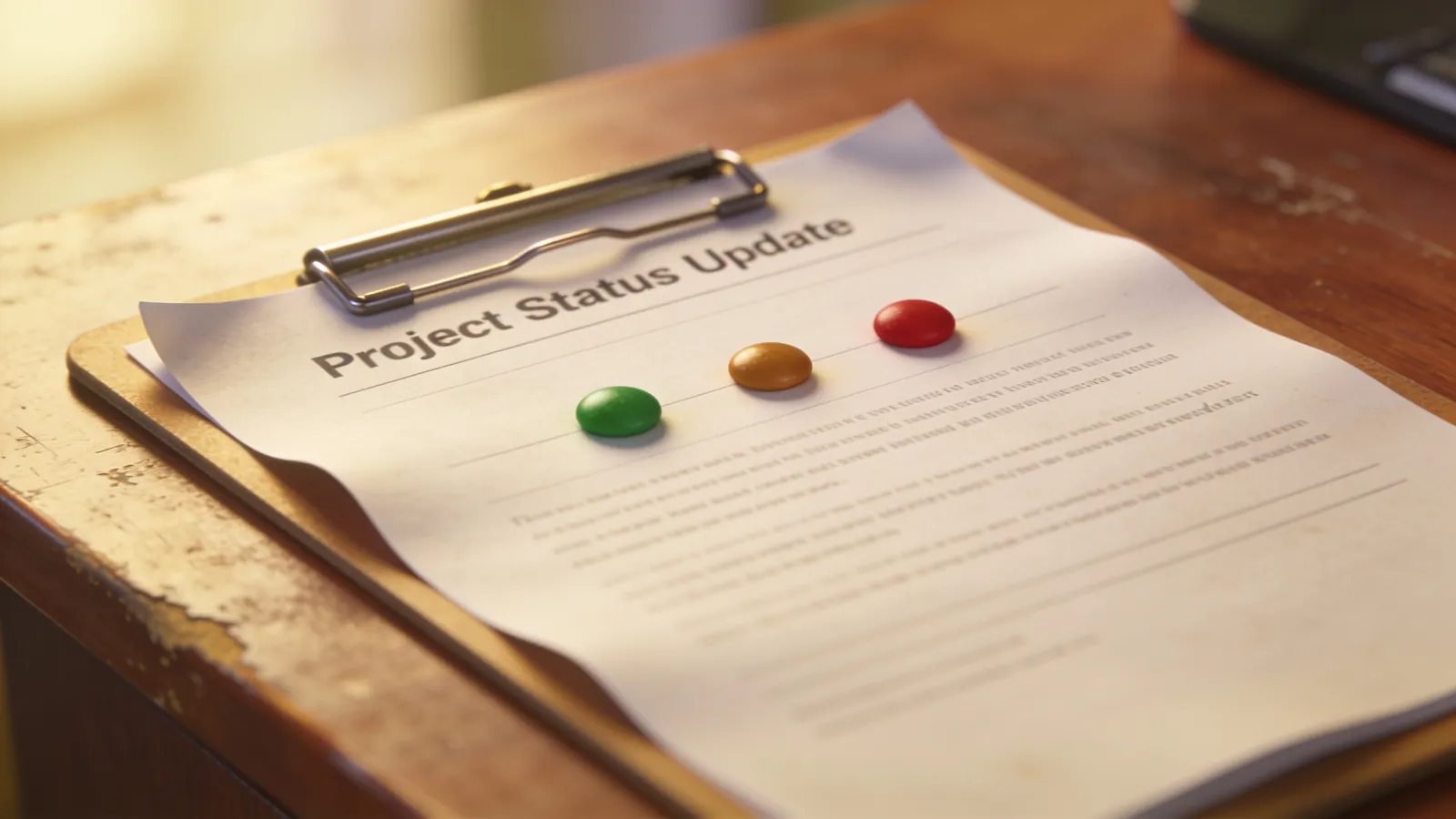
- Status in one line: a color and a sentence on why. "Amber: the permit is two weeks late, and we are working on an alternative."
- Three numbers: progress, budget and one number that matters for this project, each with a trend. Choose them with the approach in data-driven project management.
- Top risks and issues: no more than three, each with an owner and a next step.
- Decisions needed: each with the options, your recommendation and the date it is needed.
- Next milestone: what happens next and when.
Put the bottom line first. Executives often read only the top third of anything, so the status and the decisions should be there. And keep the format stable: a sponsor who knows exactly where to look for the decision list will actually look. If you would like to see how to design the numbers section so that it honestly guides decisions, read dashboards without vanity metrics.
Make asks small, specific and dated
The quality of your asks determines how fast things move. A good ask has four properties: it is small enough to answer in a few minutes, specific about what is needed, dated, and accompanied by your recommendation.
Compare two versions of the same request. The first: "We have a problem with the vendor and need your help." The second: "The vendor wants a ten percent increase to hold the delivery date. Option A: pay it and keep the date. Option B: refuse and accept a three-week delay. I recommend A because the delay would cost us more than the increase. I need your decision by Thursday at noon." The second version can be answered in thirty seconds, by phone, from an airport. The first will sit in an inbox.
This leads to the rule I would put on a poster: bring options, not problems. When you present only a problem, you hand your sponsor homework. When you present options and a recommendation, you hand them a decision, and most of the time they simply say yes.
Use the checklist below to see how well your current sponsor relationship is set up. Tick only what is already true.
Choose the right rhythm and respect the no-surprises rule
How often should you talk? There is no universal answer, but a good default is a short weekly touchpoint of ten to fifteen minutes, or a written update on weeks when a call is not needed, plus a longer review at the end of each phase. Adjust to the project's pace and the sponsor's preference, and ask them what they prefer.
Pair the rhythm with an iron rule: no surprises. If something goes wrong, the sponsor hears it from you, quickly, and with a proposed response. Bad news does not age well. The same issue reported on the day you discover it is a manageable event. Reported three weeks later, it is a breach of trust. A common refrain from executives is some version of this: "I can handle bad news. I cannot handle bad news that I learn from someone else." Make yourself the first source, always.
When something is moving fast, agree on an informal signal, like a short message, that means "I need five minutes today." Because the weekly cadence has built trust, the sponsor will respond.
Give your sponsor wins to carry
Sponsors have their own bosses, boards, clients or investors. They need good news to carry upward, and it is part of your job to supply it. That does not mean spin. It means finding the real wins and packaging them so they travel: a milestone reached early, a customer quote, a before-and-after number, a team member who learned something new.
A short sentence in the weekly update, labeled "Win this week," works well. Over a few months it becomes a story: the project is making visible progress, and the sponsor looks smart for backing it. A sponsor who is proud of the project is a sponsor who will fight for its budget when times are tight.

When the sponsor is the problem
Sometimes, despite your best efforts, the sponsor is the weak link. They are absent, or they micromanage, or they change their mind weekly. This is not a reason to complain in the corridor. It is a project risk, and you manage it like any other risk.
If the sponsor is absent, ask for a delegate with real authority and agree on what the delegate can decide. Write down decisions to show the cost of delays in plain terms: "The decision on option B is now seven days old, and the delay has added an estimated two weeks to the schedule."
If the sponsor micromanages, offer more structured visibility in exchange for fewer interruptions. Often micromanagement is anxiety in disguise, and a reliable one-page update calms it.
If the sponsor keeps changing direction, introduce a light change control: each change is written with its impact on cost, time and scope, and the sponsor signs it. This is not bureaucracy, but a mirror. I discuss how to do it without friction in how to stop scope creep.
If none of that works, raise it respectfully with the sponsor's own leader or through a steering group, framed as the project's need rather than a complaint about a person.
How different projects change the sponsor's role
The shape of the role depends on the project. In public works, the sponsor is often an agency official who is accountable to oversight bodies, so documentation and formal approvals matter more than speed. In a startup, the founder is both sponsor and doer, so the risk is not absence but overload: you may need an outside advisor to play the challenger. In an internal change project, the sponsor's visible championing is the main ingredient, as described in change management and the people side of projects. In a partnership or investment project, the "sponsor" may be a board or an investor group, which makes the rhythm and the quality of written updates even more important. And in an opening project, like the clinic or lodge openings I wrote about in how a clinic opens on time, the sponsor's most valuable contribution is to make quick calls on trade-offs as the date approaches.
Three situations, three responses
Theory is easy; the real test is how you respond in the moment. Here are three common situations, described as illustrations rather than real cases.
The sponsor says yes to everything and then goes quiet. Agreement without follow-through is a warning sign. The response is to convert each yes into a visible commitment: "Thank you. I will write this up as a decision, with the date, and send it to the team so we can move." A written decision is harder to forget and easier to enforce.
The sponsor suddenly asks for a lot of detail. This often signals a worry that you have not heard yet, perhaps pressure from their own leadership. The response is to ask, gently, "What are you being asked about that I should help with?" Then adjust the update so that it answers the question behind the question. The extra scrutiny usually fades once the worry has an answer.
The sponsor asks you to add something that was not planned. The temptation is to say yes to keep the relationship warm. The better response is to treat it as a decision with a price: "We can add it. It will cost about this much and move the finish by about that long. Which would you like to trade for it?" You are not refusing. You are making the trade-off visible, which is what a sponsor is for.
In all three, the principle is the same: respond to the sponsor's real need, keep the exchange short and leave a written trail. Over time, this is how a project manager stops being a messenger and becomes a trusted partner who is invited to the important conversations.
A short script for the first conversation
If you are about to start with a new sponsor, here are three questions that open the right conversation. "What does success look like to you, in one sentence?" "What are you most worried about?" "How would you like to hear from me, and how often?" Write down the answers and read them back. You will have your sponsor charter in fifteen minutes, and a relationship based on clarity instead of hope.
Engaging an executive sponsor is not nagging and it is not flattery. It is design: a clear role, a short regular update, small dated asks and early honesty. If you want help setting up this rhythm in your own projects, it is a core part of how I work in the startup advisory service and with Project Focus.
What is the one thing a sponsor did that made your project easier? Tell me in the comments.
Frequently asked questions
What is the role of an executive sponsor in a project?
The sponsor owns the business case, removes obstacles the team cannot, makes decisions above the project manager's authority, protects the project from competing priorities and champions the change inside the organization.
How often should a project manager update the sponsor?
A good default is a weekly one-page update or a ten to fifteen minute call, plus a longer review at the end of each phase. Agree on the rhythm at the start and adjust to the sponsor's preference.
What should a sponsor update include?
The status in one line, three key numbers with trends, up to three top risks or issues with owners, the decisions needed with options and a recommendation, and the next milestone.
What can I do if my sponsor is not engaged?
Clarify the role in writing, shrink and sharpen your asks, ask for an empowered delegate, show the cost of delayed decisions in plain terms and, if needed, raise the issue through the sponsor's own leader or a steering group.
Join the conversation
Did this help? A quick reaction tells me what to write next.
Be the first to react.





Loading comments…