News · 6 min read
UDOT's $2.8 billion season: staging, closures and communication on I-215 West
UDOT's season includes I-215 West: 30 bridges, ramps that close in stages and weekly updates. Five habits any project manager can borrow.
 Dennis AlejoBusiness consultant · Project & operations manager · · 1,367 words
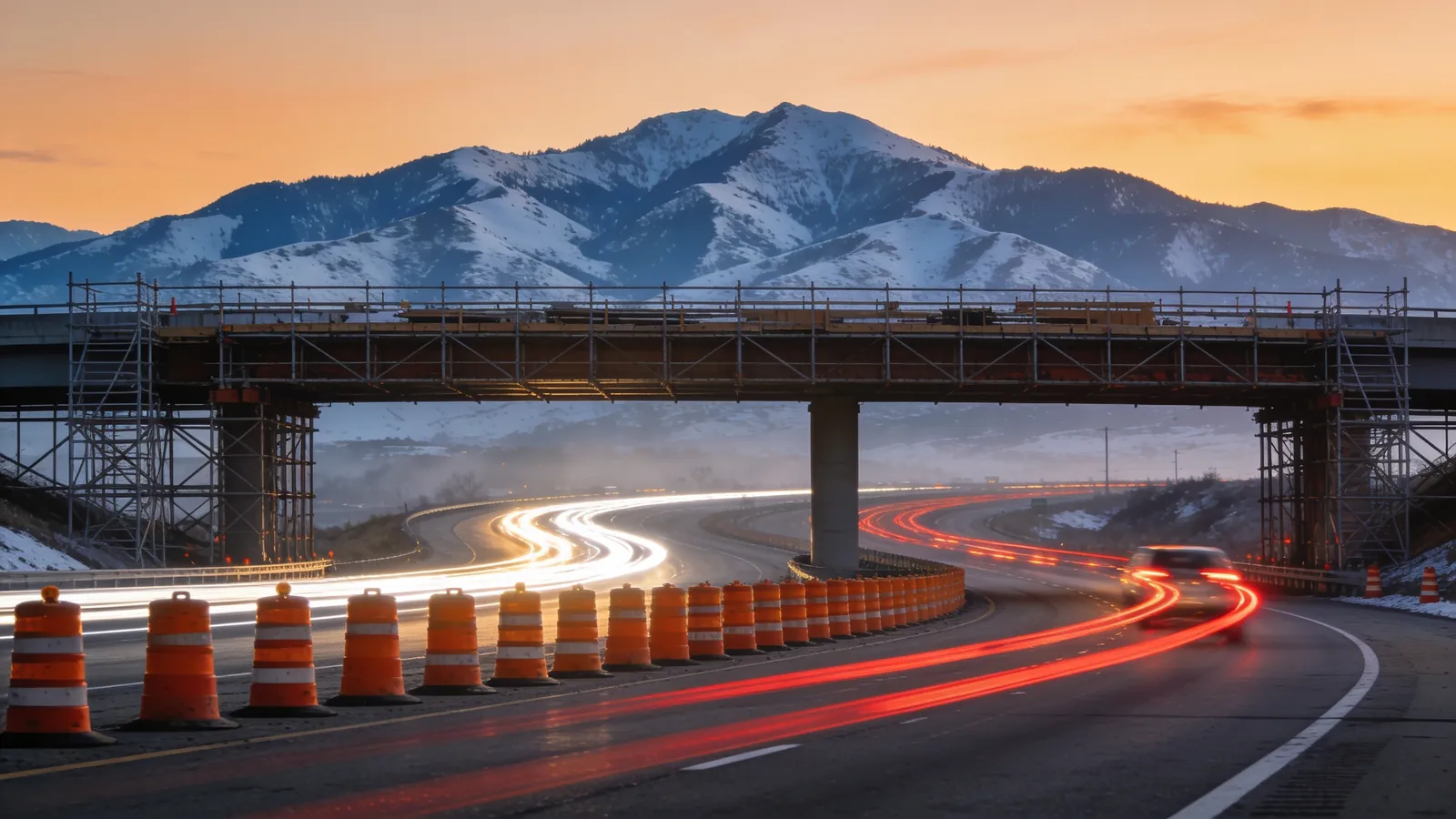
Driving on the Wasatch Front this year has felt a little like living inside a very large and very orange board game. Cones appear, ramps vanish, a sign says that the exit you use every day will return in about 20 days, and the whole thing is somehow still moving. It is easy to complain about it. It is more interesting, for a project manager, to ask how a job this big keeps the public informed while it is being rebuilt in front of them.
This post is a plain-language look at what the Utah Department of Transportation (UDOT) has said publicly about its 2026 construction season and one project in particular, I-215 West Improved, and at what small teams can borrow from it. It is not a traffic report, and traffic conditions change daily. For the current status of any road, the source is UDOT itself.
What was announced
These are the facts as UDOT's releases and project page present them.
- The season. On March 26, 2026, UDOT announced $2.8 billion in new and ongoing construction: 176 new projects starting this year and 57 continuing from before. The work covers pavement and bridge repair, safety upgrades, relief for congested corridors and options for walking, biking and transit. UDOT Deputy Director Lisa Wilson was quoted saying that every project is about taking care of the system Utahns rely on every day. The release does not say where the money comes from, so I will not guess.
- The project. I-215 West Improved is listed at $150 million in the March release. The project page describes reconstructing and resurfacing I-215 from SR-201 north to North Temple, rehabilitating 30 bridges, improving about 14 miles of ramps, including pavement reconstruction on the I-80 and California Avenue ramps, and building a new southbound auxiliary lane from 700 North to westbound I-80. All traffic is shifted onto newly reconstructed pavement on the west side. The page lists construction from July 28, 2025 through summer 2027.
- The ramps. In March, UDOT warned of spring and summer ramp closures at every ramp in the I-80 and I-215 interchange: not all at once, but with some overlapping. On July 27 it announced that three northbound I-215 off-ramps would close from July 28, two of them, to westbound and eastbound I-80, for about 35 days and one, to Redwood Road, through October 2, with airport-bound drivers told to use Bangerter Highway, I-15 or SR-201. On October 1 it announced four more ramp closures starting October 6 for bridge work, each expected to last about 20 days, among them eastbound I-80 to Redwood Road and northbound I-215 to Redwood Road. The ramp from Redwood Road to northbound I-215 is closed through July 2027.
- The scope in bridges. UDOT describes replacing 18 bridge decks and repairing 12 more bridges, which adds up to the 30 mentioned above, with work expected to wrap up in late summer 2027.
- A caution UDOT repeats. Schedules depend on weather and material availability and may change.
How the information reaches people
Here is the part I find most useful as a project manager. The project page lists several ways to stay informed: a website with an overview and an alternate-routes tab, an option to create an account for alerts, an email address, a hotline, and a weekly update by email for people who ask. The releases point to the UDOT Traffic website and app, and to UDOT's social media for real-time news. The project page also lists, plainly, what to expect: lane closures, reduced speeds, noise, dust, vibration and heavy equipment.
I have not seen the communication plan behind all this, only its visible surface. What I can say is that the surface is doing several things a communication plan should do, which is why this is a better case study than another story about delays.
Five habits worth borrowing
These are my reading of the public information, not a claim about UDOT's internal reasoning.
1. Stage the disruption. UDOT says that not every ramp in the interchange closes at once. Closures come in waves of weeks, each with a start and an approximate end. A single huge closure would be quicker on paper and unbearable in practice. On any project, ask what the least disruptive sequence is and not only what the shortest one is. Small teams do this with a customer-facing system migration, an office move or a restaurant remodel: close one thing at a time, and keep the rest running. It is the same logic as the critical path with a customer standing on it.
2. Publish the date and the caveat together. "About 20 days." "Through October 2." "Schedules depend on weather and may change." Each date is concrete enough to plan around, and the honesty about uncertainty is built into the sentence. People forgive a date that moves when they were told it might. They do not forgive a date that was promised as certain. See construction schedule delays for the usual causes of moving dates.
3. Give people one place to look. A project with a website, an app, an email list, a hotline and social media can easily become five versions of the truth. UDOT's materials keep pointing to the same sources, and each release says where to check for updates. Choose one home for your project's current status and send everyone there. The status report guide shows how to keep it to one page.
4. Say who needs a detour. The July release names a specific group, airport-bound drivers, and a specific alternative. A general message to "all drivers" helps nobody. Identify who is hurt most by each change and give that group its own instruction. In a business, that might be the customers who book on Mondays or the supplier whose delivery window moves.
5. Plan the communication for the whole length of the job. The project runs from 2025 to 2027. Interest fades after the first headline and returns when a ramp closes near your home. A weekly email, a hotline and a page that is updated, the project page showed an update date of October 22, keep the channel alive between the big announcements. Treat communication as a work package with an owner and a schedule, like the communication plan in any project.
What I do not know
I have not read the contract, the schedule or the traffic management plan, and I have not seen the contractor's side of the work. I cannot tell you whether the project is ahead or behind. The facts above come from UDOT's public pages, which are written for drivers and not for project managers. If you live or work near the project, the right place for current closures is the UDOT Traffic website or app, and the project's own page for alerts.
A note for businesses near the work
If your shop, office or clinic sits near one of these ramps, a few practical habits from the project world help, whatever the schedule ends up doing. Subscribe to the project's updates, so you hear about closures from the source. Tell your customers and staff the alternate routes before they ask. Put the closure dates in your own calendar, with the caveat that they may move. And consider a short checklist for each wave: which deliveries, appointments and shifts does this change? It is the same risk register discipline you would use on any project, shrunk to one page.
Related reading
Utah is also lining up the projects around the 2034 Winter Games, which I covered in Utah is getting ready to build again for 2034. For a deeper look at how owners and project managers think about construction work, see project management in construction and the series on construction project management from a civil engineer's desk. If you want help planning disruption and communication for a project of your own, that is part of what I do with Project Focus, and you can write to me on the contact page.
This post summarizes public information from UDOT as of October 28, 2026 and reflects my own reading, not an official position. It is not traffic, legal or financial advice. Check UDOT directly for current road conditions.
Sources
- UDOT: lane and ramp closures across the Wasatch Front (Oct 1, 2026)
- UDOT: three northbound I-215 off-ramps close (Jul 27, 2026)
- UDOT: $2.8 billion in new and ongoing 2026 construction (Mar 26, 2026)
- UDOT: I-215 West Improved project overview
Facts come from the sources above. The reading of those facts is mine.
Monthly newsletter
Everything new, once a month.
One email on the 1st of every month with everything new: articles, series parts, news, website updates, project results, where I am working and the business opportunities I am looking at. No spam.