
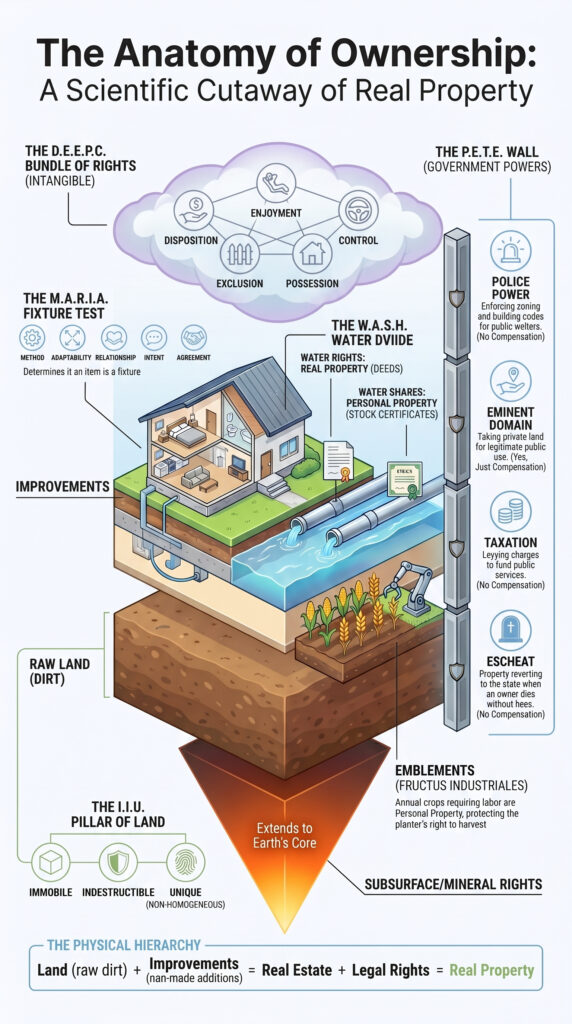
The Sandy Chandelier Fiasco: Ripped Out at the Finish Line
I recently sat down with an experienced broker from our Salt Lake network who recounted a luxury closing in Sandy that nearly devolved into a fistfight because of a single light fixture. The transaction was valued at 950,000 dollars. All operational signals were green: financing had cleared, the appraisal hit the exact contract price, and the buyers were ready to wire their down payment.
Then came the morning of the final walkthrough.
The seller—a woman the office affectionately dubbed “Sentimental Susan”—decided at 5:00 AM on closing day that her grandmother’s 8,000 dollars Austrian crystal chandelier was simply too precious to leave behind. She did not notify her agent. She did not submit an addendum. She did not check the Real Estate Purchase Contract. Instead, she climbed a ladder, cut the wires with a pair of rusty pliers, and replaced the luxury fixture with a bare, dangling 0.60 dollars lightbulb that flickered like a dying hope in a interrogation room.
When the buyers walked in, they did not see “family history.” They saw a jagged hole in the plaster, exposed copper wires, and a flagrant, active breach of contract. Susan’s defense was classic: “It is a family heirloom. It is personal to me. Therefore, it is personal property.”
Susan was dangerously wrong. In Utah, sentimentality has zero standing in a court of law. That chandelier was a Fixture. It was attached to the structure with the manifest intent of permanency. Susan’s “grandmother defense” ended up costing her 12,000 dollars in repair credits, seller concessions, and legal offsets just to keep the deal from collapsing.
If you want to survive the Pearson VUE licensing exam and build a sustainable career in this state, you must master the boundary where Real Property ends and Personal Property (Chattel) begins.
The Infrastructure of Ownership: Land vs. Real Estate vs. Real Property
In professional operations, these three terms are not interchangeable. Using them as synonyms in front of an underwriter, an attorney, or a sophisticated commercial client instantly exposes you as an amateur. You must learn the precise physical and legal hierarchy of these assets.
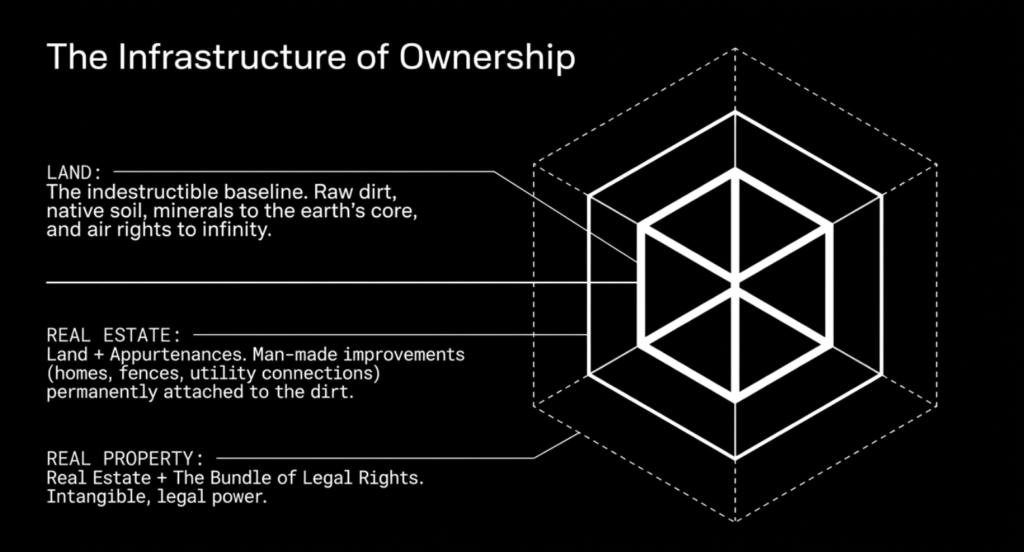
1. Land: The Indestructible Baseline
Land is the raw, natural infrastructure of our planet. It includes the surface of the earth, everything naturally attached to it (like native soil, rocks, and water), the minerals beneath (running downward in a wedge shape to the center of the earth), and the air rights above (extending upward to infinity).
To master the national portion of the exam, you must lock in the three physical characteristics of land using the I.I.U. Pillar protocol.
- Immobility: You cannot move a parcel of land. While you can dig up the soil and haul it away in dump trucks, the physical, geographic coordinates on the face of the Earth remain permanently fixed. You cannot relocate a high-value lot from Salt Lake City to Park City to bypass zoning or increase its market value.
- Indestructibility: Dirt is durable. You can flood a parcel, pave it over with asphalt, construct a bunker, or let a wildfire sweep across the surface, but the geographic space itself remains. You can destroy the improvements, but the land itself is permanent.
- Uniqueness (Non-homogeneity): No two parcels on Earth are identical. Even two side-by-side lots in a suburban development feature different geographic coordinates and receive varying levels of sunlight, drainage, and access. This physical characteristic is the absolute bedrock of the legal remedy of Specific Performance. Because every parcel of land is legally unique, money alone cannot compensate a buyer if a seller defaults. A buyer can sue for Specific Performance, demanding that a judge force the seller to sign the deed and transfer that exact, unique coordinate.
2. Real Estate: Land + Improvements
Land becomes “Real Estate” the moment you add Appurtenances. An appurtenance is defined as any improvement or right that “runs with the land.” These appurtenances are permanently attached to the raw dirt, changing its physical utility and economic profile.
- Natural Appurtenances: Trees, perennial shrubs, native grass, and natural watercourses.
- Man-made Improvements: Residential homes, commercial warehouses, fences, asphalt driveways, inground swimming pools, and utility connections. If a structures is bolted, nailed, or cemented to the land, it has transitioned from raw land into Real Estate.
3. Real Property: The Legal Power (The Bundle of Rights)
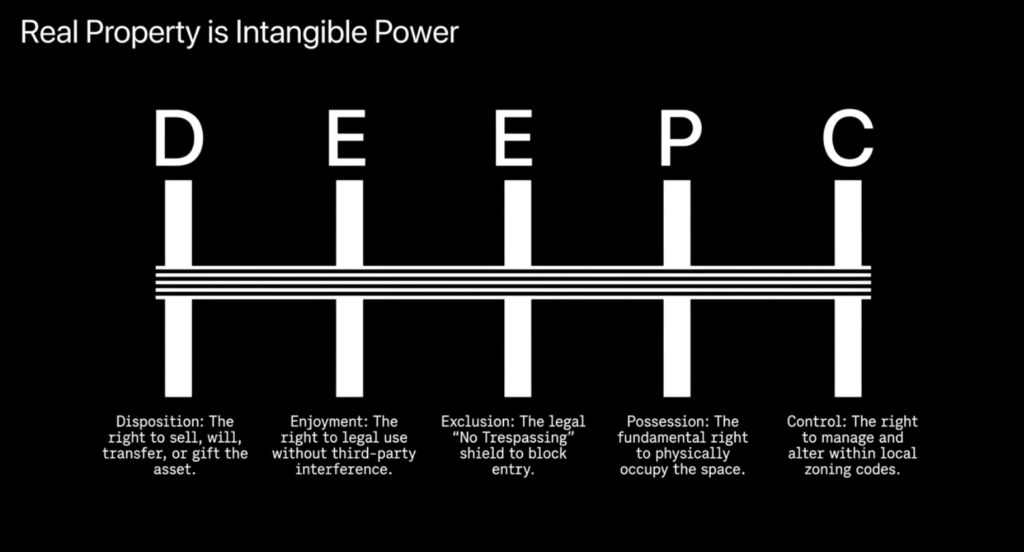
Real Property is the physical Real Estate plus the Bundle of Legal Rights that accompany ownership. When a buyer purchases a property, they are not just buying lumber, brick, and grass; they are buying a bundle of intangible legal sticks. Each stick represents a distinct, individual power that can be kept, sold, leased, or licensed.
- Disposition: The right to sell, will, transfer, gift, or otherwise dispose of the asset.
- Enjoyment: The right to use the property in any legal manner without interference from third parties or historic claims of superior title.
- Exclusion: The right to keep others from entering or using your land. This is your legal “No Trespassing” shield.
- Possession: The basic right to occupy the premises and claim physical occupancy of the space.
- Control: The right to manage, alter, improve, and utilize the property and its profits within the boundaries of local zoning laws, building codes, and private restrictive covenants.
The Economic Pillars: Why Dirt Costs Money
As an operational strategist, you must understand that real estate values are driven by social preferences and economic limits. While the physical characteristics of land are permanent, its economic value is highly volatile. You must master the four economic characteristics of land using the S.I.P.A. protocol.
- Scarcity: While the planet has plenty of raw land, usable, high-utility land in specific, high-demand areas is extremely limited. The supply of flat, buildable land along the Wasatch Front is constrained by mountains on one side and a lake on the other. This geographic scarcity drives values upward.
- Improvements: The economic profile of a parcel changes completely based on what is built on it, as well as what is built around it. Constructing a regional airport or a high-end shopping center nearby can dramatically increase or decrease the economic value of adjacent land.
- Permanence of Investment: Real estate development requires massive, upfront capital investments in “immobile” infrastructure—sewer lines, electrical grids, concrete foundations, and roadways. This capital is frozen. You cannot easily liquidate a commercial building in twenty-four hours to move your funds into a different market. This permanence makes real estate a long-term, high-stakes commitment.
- Area Preference (Situs): This is the social value of location. It is not about raw geography; it is about human preference. People will pay a massive premium to live in a specific school district, near a historic district, or in a neighborhood with a high-status reputation. Situs is the economic translation of human desire.
The Decision Diagnostic: M.A.R.I.A.
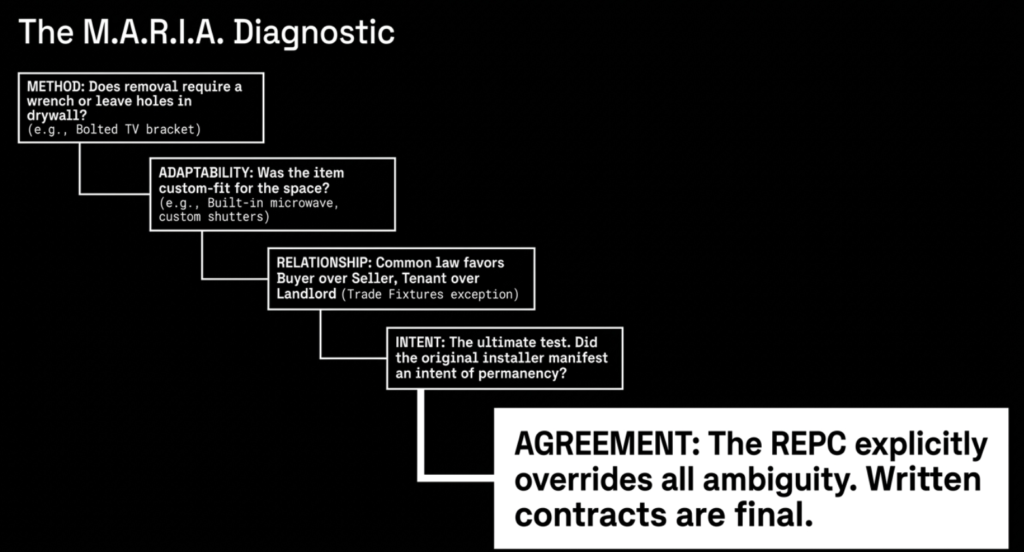
When you are conducting a listing walkthrough and you spot a built-in sound system, custom shelving, or a luxury kitchen appliance, do not guess whether it stays with the house. Run the M.A.R.I.A. diagnostic. This five-point legal test is your primary defense against transaction-ending disputes like the Sandy Chandelier fiasco.
1. Method of Annexation
How is the item physically attached to the property? This is the classic “Tools and Damage” test. If removing the item requires a screwdriver, a wrench, or a crowbar, and leaves holes in the drywall, scars on the timber, or structural damage, the item is almost certainly a fixture.
- Operational Application: A modern flat-screen television is personal property because it can be easily unplugged and lifted off its mount. However, the heavy steel mounting bracket that is bolted directly into the wall studs? That bracket is a fixture. If your seller unscrews that bracket and leaves gaping holes in the drywall, they are in breach of contract unless they repair the damage.
2. Adaptability of the Item
Was the item custom-made, modified, or uniquely adapted for the specific space it occupies?
- Operational Application: A standard, plug-in microwave sitting on a granite countertop is personal property (chattel). However, a microwave that is built directly into a custom cabinet frame, matching the surrounding woodwork and vents, is a fixture. Similarly, custom-fit wooden plantation shutters, even if they can be easily popped out of their hinges, are fixtures because they were manufactured specifically for those window frames.
3. Relationship of the Parties
If a fixture dispute escalates to a court of law, judges do not operate in a vacuum. Under common law, if there is ambiguity in the contract, courts will almost always favor the Buyer over the Seller, and the Tenant over the Landlord.
- The Trade Fixtures Exception: In commercial leasing, business tenants must install specialized equipment to operate (e.g., pizza ovens in a restaurant, hydraulic lifts in an auto shop, or dental chairs in a clinic). These are classified as Trade Fixtures. Under the law, Trade Fixtures are Personal Property of the commercial tenant. The tenant has the absolute right to remove them before the lease expires, provided they restore the premises and repair any physical damage caused by the removal.
4. Intent of the Annexor
This is the single most important factor in the M.A.R.I.A. diagnostic. When the item was originally installed, did the person doing the installation intend for it to become a permanent part of the real estate?
- The Susan Test: No reasonable homeowner installs a highly complex, heavy, 8,000-dollar crystal chandelier into a dining room ceiling junction box with the intent of taking it down like a temporary holiday decoration. The sheer effort and expense of the installation manifest a clear intent of permanency. Susan’s emotional attachment after the contract was signed does not retroactively change her original intent.
5. Agreement (The Final Word)
In Utah, the Real Estate Purchase Contract (REPC) is the absolute authority. Written agreements on UAR-approved forms overrule all other M.A.R.I.A. factors. If a buyer and seller sign a contract that explicitly states the seller’s lucky plastic garden gnome in the flowerbed will remain, that gnome is legally treated as real property by agreement. If Susan wanted to keep her chandelier, her agent’s sole duty was to write it clearly under the “Exclusions” section of the REPC before anyone signed.
Mental Blueprint: Imagine a professional forensic investigator named ‘Maria’ walking through a house. She wears a slate-grey tactical vest and holds a high-tech magnifying glass that glows with a gold light. She points the glass at a wall-mounted bracket where a TV once hung; the glass highlights the heavy bolts driven into the wall studs, labeling them ‘Method of Annexation’. She points it at a custom-fit window frame, and it highlights ‘Adaptability’. Finally, she pulls out a physical, signed copy of the REPC, pointing to a highlighted clause under Section 1.1, showing that ‘Agreement’ always seals the final decision. This is the M.A.R.I.A. protocol.
The Conversion Mechanic: Annexation vs. Severance
Real estate is not static. Real property can be converted into personal property, and personal property can be converted into real property through two basic physical and legal actions:
- Annexation: The physical process of transforming Personal Property into Real Property.
- Example: You drive to Home Depot, purchase a stack of cedar lumber, a box of screws, and a bucket of concrete. At this moment, these items are chattel (personal property) sitting in your truck. Over the weekend, you dig holes, pour the concrete, and build a deck attached to your home. Through annexation, you have permanently attached those materials to the real estate, converting them into Real Property.
- Severance: The physical process of transforming Real Property into Personal Property.
- Example: There is a towering pine tree growing in your backyard. It is natural growth, rooted in the soil, making it Real Property. You take a chainsaw, cut the tree down, and split it into neat cords of firewood. By severing the tree from the land, you have converted it into Personal Property (firewood) that you can sell or haul away.
The Agricultural Exception: Emblements and Fructus
When analyzing land transactions, Pearson VUE will relentlessly test your understanding of agricultural assets. You must know how the law classifies plants and crops, as this determines who has the right to harvest them after a sale.
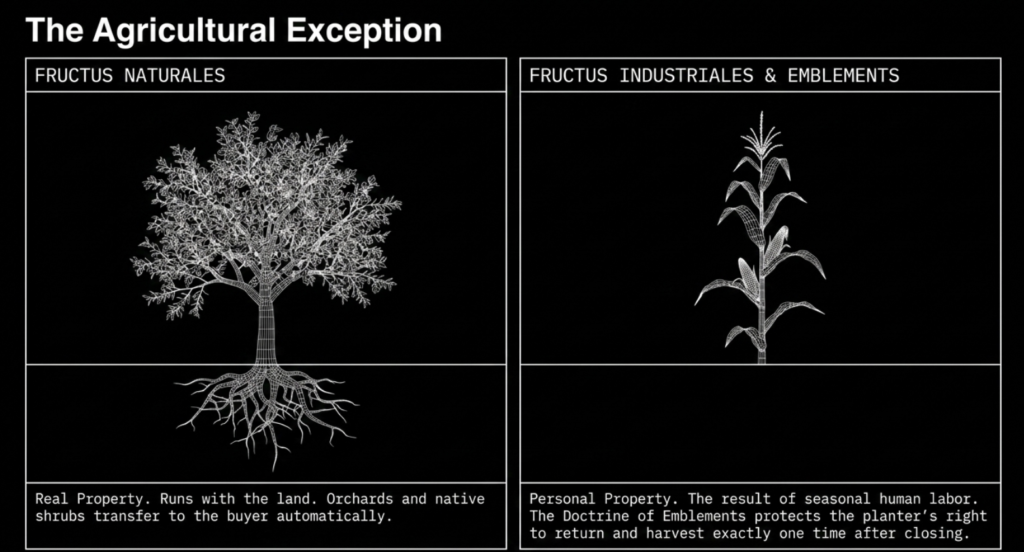
1. Fructus Naturales (Natural Fruits)
These are trees, perennial shrubs, wild berry bushes, and native grasses that do not require annual planting or labor. They are classified as Real Property. They are rooted deep in the soil and run with the land. When a farm or home is sold, the orchards and landscaping automatically transfer to the buyer.
2. Fructus Industriales (Industrial Fruits or Emblements)
These are annual crops that require seasonal planting, cultivation, and active human labor (e.g., corn, wheat, barley, soybeans, and backyard vegetable gardens). Because these crops are the direct result of seasonal, industrial labor, the law classifies them as Personal Property.
3. The Doctrine of Emblements
This common-law doctrine protects agricultural tenants and sellers. If a tenant farmer or a landowner plants an annual crop, and the land is sold, leased to someone else, or foreclosed upon before the crop matures, the planter maintains the legal right to return to the land to harvest that crop one time after the transaction closes.
- Operational Field Standard: If you are listing a home in Utah County with a beautifully manicured, massive summer vegetable garden, you cannot assume the buyer will take over those crops. You must clarify in writing whether the seller has the right to access the property to harvest their tomatoes and squash in August, or if the garden is being transferred entirely to the buyer. Put it in writing to prevent post-closing trespass disputes.
Mental Blueprint: Imagine a split-screen field along the base of the Wasatch mountains. On the left, picture a heavy winter snow falling over a cherry orchard; the deep, ancient roots of the trees are frozen solid into the earth, representing permanent ‘Fructus Naturales’ (Real Property). On the right, picture a bright summer harvest where a farmer in overalls stands next to a ‘Sold’ sign in a field of tall corn. He is holding a basket and pointing a legal document at the new buyer, which allows him to harvest his corn one last time. This is the ‘Doctrine of Emblements’ (Fructus Industriales) protecting his personal labor.
The Utah REPC Surgical Strike: Section 1.1
In Utah, we do not rely solely on the ambiguities of common-law tests. Our primary weapon of transaction management is the Utah Association of Realtors (UAR) approved Real Estate Purchase Contract (REPC).
Section 1.1 is your technical armor. It contains a comprehensive, pre-printed list of items that are explicitly included in the purchase price of the property, regardless of whether they pass the common-law M.A.R.I.A. test. These pre-checked items include:
- Plumbing, heating, and air conditioning fixtures.
- Water softeners and water filtration systems.
- Window screens, storm doors, and custom window blinds.
- Light fixtures, bulbs, and ceiling fans.
- Wall-mounted television brackets (note that the TV itself is excluded, but the bracket must stay).
- Range, oven, and built-in microwave.
A colleague of mine once reviewed a litigation file from a brokerage in Provo where an agent failed to explain Section 1.1 to their seller. The seller had a leased water softener. Believing it was personal property because they paid a monthly rental fee, the seller disconnected the unit on moving day, packed it up, and returned it to the leasing company. The buyer moved in, discovered there was no water softener, and demanded a replacement. Because the seller had signed the REPC without excluding the water softener, they were legally forced to buy out the lease and pay 2,500 dollars to install a brand-new unit for the buyer.
- The Operational Rule: If an item is listed in Section 1.1, it stays. If your seller wants to keep their smart home thermostat, their high-end video doorbell camera, or their water softener, you must write those items down in the Exclusions section of the REPC before signing. Never rely on a verbal handshake.
The Desert’s Hidden Poison: Water Shares vs. Water Rights
This is the single most dangerous technical territory in Utah real estate. In many eastern and midwestern states, water follows the land like a shadow. If you buy a farm next to a river, you automatically receive the right to use that water.
Utah is a desert state operating under the Doctrine of Prior Appropriation. In Utah, water is a completely separate property right. You can own 40 acres of prime soil, but if you do not own the water rights, you cannot legally divert a single drop of water to keep your crops alive.
You must memorize the strict divide between Water Rights and Water Shares for the state portion of the exam.
1. Water Rights: Real Property
A Water Right is the legal right to divert and use water from a natural source (like a river, stream, or underground aquifer). It is classified as Real Property.
- Water Rights are recorded at the Utah State Engineer’s office (Division of Water Rights) in Salt Lake City.
- They are transferred from one owner to another using a Deed (such as a Water Deed or a standard Warranty Deed) and must be recorded in the county recorder’s office where the water is diverted.
2. Water Shares: Personal Property
A Water Share represents ownership in a private, non-profit mutual water company or irrigation ditch company. The company holds a master water right, and you own shares of stock in that company. Each share entitles you to a proportional allotment of water (e.g., three acre-feet of water per share). Water Shares are classified as Personal Property.
- Water Shares are not recorded at the State Engineer’s office or the county recorder’s office.
- They are transferred using a Stock Certificate issued directly by the mutual water company. To transfer ownership, the seller must physically sign the back of the stock certificate and hand-deliver it to the escrow officer, who then submits it to the water company to issue a new certificate in the buyer’s name.
3. The W.A.S.H. Protocol
An agent from our Salt Lake network once closed a five-acre horse property in Utah County. The agent saw water flowing through the irrigation ditches, assumed the water “came with the land,” and checked the standard box in the REPC.
However, the water was held in shares of a private ditch company. Because the agent did not secure the physical stock certificate at closing, the seller realized they still held the stock, walked into the ditch company’s office, and sold those water shares to a neighboring rancher for 40,000 dollars cash the week after closing. The buyer ended up with a five-acre dust bowl, dead pastures, and a massive professional negligence lawsuit against their own agent.
You must protect your client’s wealth using the W.A.S.H. protocol:
- W – Water Rights: Real Property (Recorded via Deed at the state).
- A – Appurtenant: Sometimes water rights are appurtenant to the land, but you must verify the title commitment to ensure they haven’t been severed.
- S – Shares: Personal Property (Transferred via Stock Certificate).
- H – Hand-delivered: Stock certificates must be physically located, signed off, and hand-delivered at closing to ensure the transfer is legally complete.
Mental Blueprint: Imagine a parched, dry Utah horse pasture under a blistering summer sun. In the center of the field, there is a giant iron water gate, locked tight with a heavy padlock. Hovering on the left side of the gate is a formal, wax-sealed deed labeled ‘Water Rights’. It is a real property document, but it does not open the lock. On the right, picture a large, ornate golden key shaped like a ‘Stock Certificate’. When the agent’s hand slides this golden stock certificate into the gate, the padlock snaps open, and cold, fresh water floods across the dusty field. The deed is the right, but the stock certificate (the Water Shares) is the physical key. This is the W.A.S.H. protocol.
Governmental Limitations: The P.E.T.E. Wall
Even if your client holds a “Fee Simple Absolute” estate (the highest form of ownership recognized by law), they do not hold absolute, lawless power over their land. The state retains four sovereign powers that act as a permanent boundary around your Bundle of Legal Rights. You must memorize these four powers using the P.E.T.E. protocol.
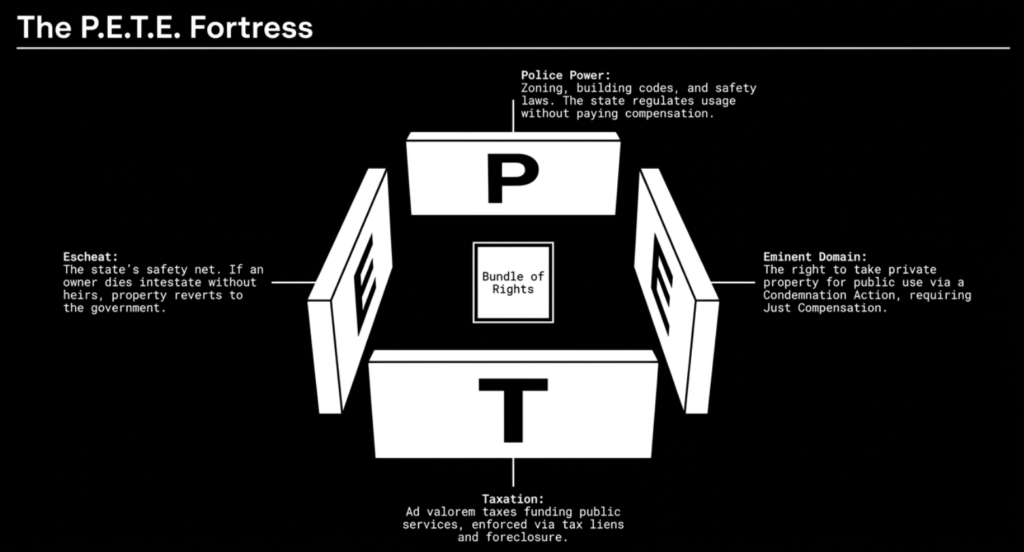
- Police Power: The right of the government to adopt and enforce laws, ordinances, and regulations to protect the public health, safety, morals, and general welfare. The government does not have to pay you a single dollar when they exercise police power, even if it limits how you use your land.
- Examples: Municipal zoning ordinances, building codes, setback requirements, environmental regulations, and subdivision plat rules.
- Eminent Domain: The right of the government to take privately owned real property for a legitimate public purpose. Unlike police power, the Fifth Amendment of the US Constitution strictly mandates that the government must pay the owner Just Compensation (fair market value determined by independent appraisals). The formal legal lawsuit filed by the government to force the taking of the land is called a Condemnation Action.
- Taxation: The right of government entities to levy ad valorem (according to value) taxes against private real estate to fund public services like schools, police departments, and roads. If a property owner fails to pay their property taxes, the county assessor can place a tax lien on the property and eventually foreclose on the home to satisfy the debt.
- Escheat: This is the government’s safety net against ownerless property. Under the law, all land must have an owner. If a property owner dies “intestate” (without a valid will) and has absolutely no legal heirs, the title to the real estate automatically reverts (escheats) to the state government.
Mental Blueprint: Picture a classic suburban home in Sandy surrounded by four massive, glowing defensive walls. The first wall, labeled ‘P’, is a giant zoning map displaying height limits and setback rules. The second wall, labeled ‘E’, shows a municipal construction plan with a public road cutting through the edge of the yard, accompanied by a government check. The third wall, labeled ‘T’, is a giant property tax ledger. The fourth wall, labeled ‘E’, shows a genealogical family tree that ends in a faded question mark, with a state seal descending over the house. This is the P.E.T.E. Fortress protecting and limiting the land.
The Dynamics of Soil and Water: Natural Changes
Land is indestructible, but its boundaries are not static. Natural forces can expand or contract your client’s physical acreage. You must master the four technical terms used to describe natural terrain changes on the exam.
- Accretion: The gradual, imperceptible addition of land by the action of water currents. The flowing water deposits soil (called alluvion) onto the bank, slowly increasing the physical size of the shoreline. Your client legally gets more dirt.
- Erosion: The gradual, slow wearing away of soil and land by natural forces like wind, rain, and water currents. Over time, your client’s shoreline slowly shrinks. Your client legally loses dirt.
- Avulsion: The sudden, violent, and rapid tearing away of land by a natural catastrophe (such as a massive mudslide, an earthquake, or a river violently changing its course during a spring flood).
- Reliction: The gradual exposure of dry land when a body of water (such as a lake or river) slowly recedes. As the water level drops, the newly exposed land belongs to the adjacent property owner.
Technical Deep Dive: Subsurface and Air Rights
Real property is a vertical asset class. You own the surface, but your ownership also extends vertically:
1. Subsurface Rights (Mineral Rights)
The rights to the minerals, oil, gas, coal, and geothermal energy lying below the surface of the earth. In Utah, these rights are frequently “severed” from the surface.
- Operational Risk: An investor buys a scenic 40-acre mountain plot in Wasatch County to build a luxury home. However, fifty years ago, a mining corporation severed and purchased the mineral rights. Under the law, the mineral owner holds the dominant estate, meaning they have the legal right to access the surface to extract their minerals, even if it ruins the homeowner’s view or driveway. Always verify the title commitment to see if the mineral rights have been severed.
2. Air Rights
The legal right to use the empty space above your land. While historic common law stated you owned to infinity, modern aviation laws have placed a practical ceiling on air rights.
- Friction Note: If a neighbor’s pine tree branches hang three feet over your property line, those branches are technically violating your air rights. Under Utah property law, you have the right to trim those branches back to the exact vertical plane of your property boundary, but you cannot cross the line onto their land, and you cannot trim the tree in a negligent manner that kills it—otherwise, you are liable for damages.
Operational Standards for Field Inventory
To protect your real estate career, your brokerage, and your clients from catastrophic lawsuits, you must integrate these three operational standards into your daily practice:
1. Perform a Walkthrough Audit at Listing
When you walk through a property with a seller to sign a listing agreement, do not just look at the paint colors. Touch every wall-mounted item. If a wall features custom wooden shelving, ask: “Is this bolted into the wall studs, or does it hang on a simple picture hook?” If they have a high-end, wall-mounted television bracket, say: “The bracket is legally a fixture and must stay by default. If you want to take it, we must list it under Exclusions in the REPC right now.”
2. Read Section 1.1 with Your Clients Line-by-Line
Never hand a blank REPC to a client and say, “Just sign here.” Open Section 1.1 and review the pre-checked included items. Ask: “Do you have a water softener? Is it owned or leased? Do you have custom window blinds you want to keep?” If they want to keep any of these items, write them in the “Exclusions” section immediately.
3. Keep Personal Property Out of the REPC
If your buyer wants the seller’s riding lawnmower, pool table, or hot tub, do not write these items into the REPC. Lenders will not finance personal property with a 30-year residential mortgage. Writing chattel into the REPC will red-flag the loan underwriter, stall the closing, and force you to rewrite the contracts. Keep personal property transactions completely separate by executing a clean, independent Bill of Sale.
Final Directive for the Day
On the licensing exam and in your career, the baseline of all real estate wealth is the land itself. If you do not know where real property ends and personal property begins, you are a walking liability to your brokerage.
Review the I.I.U., D.E.E.P.C., P.E.T.E., and W.A.S.H. mnemonics. Lock in these mental blueprints. Tomorrow, we move to the literal geometry of the land—how we map, measure, and verify boundaries using surveys.
Core Takeaway: Technical literacy regarding Fixtures vs. Chattel is your first line of defense against transaction collapse. Use M.A.R.I.A. to diagnose risk, use the REPC Section 1.1 to seal the deal, and never forget the W.A.S.H. protocol for Utah water.
There is definately a lot to find out about this subject. I like all the points you made
Awesome! Its genuinely remarkable post, I have got much clear idea regarding from this post
I truly appreciate your technique of writing a blog. I added it to my bookmark site list and will
Pretty! This has been a really wonderful post. Many thanks for providing these details.
I like the efforts you have put in this, regards for all the great content.
I do not even understand how I ended up here, but I assumed this publish used to be great
I appreciate you sharing this blog post. Thanks Again. Cool.
very informative articles or reviews at this time.
Hi there to all, for the reason that I am genuinely keen of reading this website’s post to be updated on a regular basis. It carries pleasant stuff.
I just like the helpful information you provide in your articles